Green Jaguar X300e

A fine example of a X300.

Silver X300

Shiny and silver.

Black X300

Bold and black.

Another example

What more to say?

Jaguar Machanic

Yep, its broke.

Friday, April 5, 2013

Module masters for faded clock repair

The clock display can disappear if the voltage or ground is poor.  Check grounds and the power pass through on the fire wall inside the engine compartment. 

Clock Modules
Description:
For this rebuild to work, your dead LCD clock must have a normal silver/beige color background. Some faded digits or parts of numbers with even color background are perfect for this rebuild. If your display glass is cracked or you notice any abnormal black hazing when the dead clock screen is viewed at certain angles; this means the polarizer element is damaged. Such repair requires a new LCD panel which is not available from any manufacturer at this time. Wait a few more months and our custom replacement panels should be available by then and will be updated here.

This rebuild is guaranteed to restore dim or missing segments in your Jaguar LCD clock. We use only the highest quality new components including your choice of blue or green LED backlighting. The original backlighting used incandescent bulbs which got hot enough to cause damage. These bulbs are replaced with cool factory-colored LEDs to ensure the LCD remains trouble free for the life of the car. We also replace the flexible PCB ribbon cable and all remaining incandescent control button lamps are replaced with brand new (twist lock as OEM) color matched lamps. New set of lamps from the dealer cost more than this rebuild alone!

Rebuild applies to all Jaguar clock/switch assemblies with or without seat heater buttons. You get:

> New microcontroller to LCD interface to restore the dead display.

> Brightness matched green LED backlighting for the LCD clock.

> All new OEM color matched incandescent lamps for control buttons.

> Lifetime guarantee of your LCD display repair which includes LED units, does not apply to incandescent lamps for buttons.

Please specify your preference of blue or green backlighting in the comments field of the order form.


Vehicle:
1996 and later Jaguar models
Price:
$90


As an alternative


Got around to investigating this yesterday. The basic problem is that most
of the segments were faint, if visible at all.

Getting to the clock is straightforward - remove the ski-slope, pull out the
climate/clock/hifi unit, disconnect the plug and undo the four screws
holding the clock module in place. There are then half a dozen little screws
on the back of the module, after which you can gently prise off the back,
which is held in place by 6 plastic lugs.

The pcb is also held by a couple of plastic lugs after which you can move
the display itself. This is connected to the pcb by a flexible plastic pcb,
which appears to be glued onto the pcb.

And here's the problem - the glue seems to die and so the connection between
main pcb and the flexible pcb is weak. Connect the thing back up to the
car,l whilst still in bits, and squeeze the plastic back down on to the pcb
and hey presto - proper display again! The left hand corner was particularly
senstive so I guess was a common return for all the segments.

I'm pretty sure my domestic glue is not conductive, so I just reglued right
on the edge of the plastic, away from the tracks. I then got a couple of
pieces of thick cardboard - actually cut from a takeout pizza box - about
30mm x 5mm and located them behind the main pcb and in front of the flexible
pcb across the length of the connection.

Fit the main pcb into it's lugs, then refit the plastic back cover. With the
card in place, it was quite hard to be able to get the lugs to click in and
hold the cover on. However, this does mean that the cardboard is pressing
real hard on that connection and when installed back in the car, all is
well.

If you get the card too thick, then either you can't get the back cover on
or if you do, the little switches to set the time don't actuate.

I guess this is the sort of repair which a lot of folk don't approve of, but
in the absence of specialist tools etc it took me an hour and a half from
start to finish, cost nothing and works fine!

Hope this is useful to someone else. I read that Richard has maybe just
developed the same problem!

Cheers - Jez

JAGUAR XJ6 X300 1995-1997 door parts list


Gas tank removal

Possible ways and solutions:

I have found the best way to get the cursed gas tank out was to lower the rear of the rear suspension. What I mean is, with the chassis properly supported on jack stands, use a floor jack to support the subframe, then loosen, but do not remove, the iron subframe mounting bolts (3 per side). Then remove the bolts in the rear cross mount "arms" ( I do not recall the correct nomenclature). lower the rear about 3 inches and you can get your hands to the fuel lines at the bottom of the tank. Of course, you need the fuel line removal tool, and I have actually found the cheap plastic ones to work better than the aluminum ones. Also, if you take a short piece of say 1/2" conduit and cut a lengthwise slot, you can use that to apply force to push the connector removal tool into the connector. I have not looked up the official time for R/R of the tank, but I would plan for a good part of a day the first time, unless you have some good help.

Possible filter replacement - Purolator PN#F65217

Detail removal instructions

Homemade tool
I have made my own tool to get the pipes out of the fuel tank. Am using a standard plastic pipe (for electrical wiring), made a large opening, so you can get it over the fuel pipe, and have made the end such (by heating) that it nicely fits the around the fuel pipe. This becomes now a 5 minute job, just slide the plastic pipe over the fuel line, push it in, and pull the fuel line out with a hook. Here are 2 pictures:


The pipe I used had an od of 19mm and id of 16mm. Then the top needs to be cut so that you can bend it around a 10mm od pipe (I used some heat so it would stay nicely round).


Choked EGR

Try a few tankfulls with Lucas Fuel Additive.

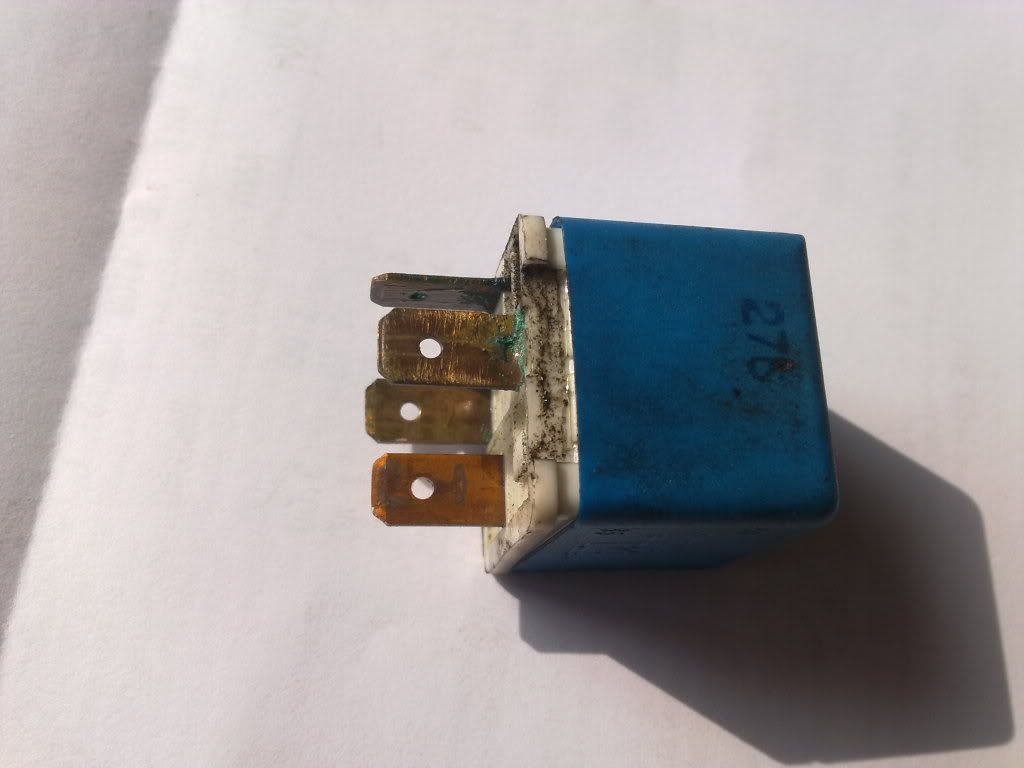
Blue vs. Black Jaguar Relays

Older XJ_ cars had blue relays. These relays were not sealed from the weather, which resulted in a series of problems.  They also developed micro fractures that would give false readings (could happen also on the newer styles).  This resulted from almost invisible filaments of solder connecting between the contact points which when current was applied would melt.

Several key relays should be checked for hard to start or no start situations. Prime ones to check are the Oxy-Sensor heater relay and the EMS main relay and fuel relay.

Here is the older Jag bulletin:
There was a Jaguar service bulletin regarding relays:

ISSUE:
The blue Hella relay (part no. DAC 7686) was used in a variety of locations and
applications on XJS and Sedan Range vehicles.

In many cases relays have been replaced without being diagnosed properly. In
other cases, the relay has been replaced with the identical relay in a location
where the use of the new sealed relay (part no. LHF 6703AA) is more suitable.
This bulletin outlines what to check before replacing a relay and where to use a
sealed relay when replacing a failed blue Hella relay.
Malfunction of the relay while installed on the vehicle can be caused by:

An invisible oxide film on the relay terminals.

Loose or damaged terminals in the relay base.
NOTE:
NOTE: On 1993-94 (4.0L) Sedan Range and XJS vehicles, the
relay controlling the AIR pump clutch should be checked or
replaced as outlined in bulletin 17-9 Service Action S 458.
ACTION:
CHECKS TO PERFORM BEFORE REPLACING RELAY
Before replacing a relay, check the following:

Remove and reinstall the relay for the affected circuit. This action is often
enough to clean off the oxide-film and allow the relay to operate correctly.
This is particularly the case in circuits where the relay switches a current of
only a few milliamps.

Tuesday, April 2, 2013

The Jaguar trouble codes found


The first alpha character identifies the system generating the code 


  • P = Powertrain
  • B = Body
  • C = Chassis
  • U = Undefined

    The second digit says if the code is generic - same for all OBD-II systems - or manufacturer specific 
  • 0 = Generic (zero)
  • 1 = Enhanced (manufacturer specific)

    The third digit is sub-system type for that code 
  • 1 = Emission Management (Fuel or Air)
  • 2 = Injector Circuit (Fuel or Air)
  • 3 = Ignition or Misfire
  • 4 = Emission Control
  • 5 = Vehicle Speed & Idle Control
  • 6 = Computer & Output Circuit
  • 7 = Transmission
  • 8 = Transmission
  • 9 = Reserved
  • 0 = Reserved


  • P0300 - Basically this means that the the car's computer has detected that not all of the engine's cylinders are firing properly. A P0300 diagnostic code indicates a random or multiple misfire. If the last digit is a number other than zero, it corresponds to the cylinder number that is misfiring. A P0302 code, for example, would tell you cylinder number two is misfiring. Unfortunately, a P0300 doesn't tell you specifically which cylinder(s) is/are mis-firing, nor why.

    DIAGNOSTIC: The simplest thing to do is to reset the code and see if it comes back. If there are symptoms such as the engine is stumbling or hesitating, check all wiring and connectors that lead to the cylinders (i.e. spark plugs). Depending on how long the ignition components have been in the car, it may be a good idea to replace them as part of your regular maintenance schedule. I would suggest spark plugs, spark plug wires, distributor cap, and rotor (if applicable). Otherwise, check the coils (a.k.a. coil packs). In some cases, the catalytic converter has gone bad. If you smell rotten eggs in the exhaust, your cat converter needs to be replaced. I've also heard in other cases the problems were faulty fuel injectors. Random misfires that jump around from one cylinder to another (read: P030x codes) also will set a P0300 code. The underlying cause is often a lean fuel condition, which may be due to a vacuum leak in the intake manifold or unmetered air getting past the airflow sensor, or an EGR valve that is stuck open.

    1. Faulty spark plugs or wires Faulty coil (pack) 
    2. Faulty oxygen sensor(s) 
    3. Faulty fuel injector(s) 
    4. Burned exhaust valve 
    5. Faulty catalytic converter(s) 
    6. Stuck/blocked EGR valve / passages, see tsb issued
    7. Faulty camshaft position sensor 
    8. Defective computer
    9. Fuel pressure to high or low
    10. Cylinder compression low.
    11. Worn camshaft/broken valve spring(s).
    12. Fuel injector(s) restricted or leaking.
    13. Fuel injector(s) continuously open.
    14. Fuel contamination.
    15. Fuel injector circuit fault(s). Injector DTCs are also flagged.
    16. Spark plug failure, fouled or incorrect gap.
    17. ECM to ignition module primary circuit fault (cylinder misfire DTC is also set).
    18. Ignition module ground circuit open or high resistance.
    19. Ignition module or coil failure.


    P0727 - Engine speed input signal missing. TCM receives no signal from the ECM. Meaning engine stalls, key still on, ECM still powered up, looking for that signal..... The Engine Control Module (ECM) monitors the engine speed through the Crankshaft Position (CKP) sensor with the engine running, and send signal to the Transmission Control Module (TCM).

    DIAGNOSTIC: Check communication error between the ECM and TCM

    1. Stuck open EGR valve. Probably the most likely candidate.
    2. Crank Position Sensor. Commonly replaced for these codes, usually never fixes it.
    3. Pops up if the car runs out of gas, overheats, fuel pump fails, or anything that could cause the engine to stall.
    4. Open or shorted CKP sensor circuit condition
    5. Poor CKP sensor electrical connection 
    6. Failed CKP Sensor 


    P1185 - Upstream lambda heater (oxygen sensor) circuit open, circuit malfunction or EGR Drive Overcurrent (depending on your year car), possible damage from overtightning (27 inch lbs needed)
    Test:
    1.      Ensure that each upstream sensor has a heater resistance of between 5.3 and 6.7 Ohms. If this gives a positive result then go to step 2. If the limits are incorrect then replace the sensor, re-connect the harness and go to step 7.
    2.      Check harness continuity PI 128/003 to PI 129/003. If this gives a positive result then switch of ignition and go to step 3. If the circuit is open then find the fault and fix it, re-connect the harness and go to step 7.
    3.      Check harness continuity PI 128/001 to PI 104/030. If this gives a positive result then go to step 4. If the circuit is open then find the fault and fix it, re-connect the harness and go to step 7.
    4.      Check harness continuity PI 128/004 to RS 006/008. If this gives a positive result then go to step 5. If the circuit is open then find the fault and fix it, re-connect the harness and go to step 7.
    5.      Check harness continuity PI 129/004 to RS 006/008. If this gives a positive result then go to step 6. If the circuit is open then find the wiring fault and fix it, re-connect the harness and go to step 7.
    6.      Check harness insulation PI 128/003 to ground. If this gives a positive result then re-connect the harness and go to step 7. If there is a short circuit then find the wiring fault and fix, re-connect the harness and go to step 7. 
    7.      Clear the fault. Then in order to check if the fault code has been cleared perform the service drive cycle. If this gives a positive result then stop. If the fault is still present then go to step 8.
    8.      Repeat the diagnostic procedure. If this now omits a positive result then stop.
     

    When testing do not test the resistance between sensor pins 3 and 4 as the generated current can damage the platinum electrodes.


    P1193 -  HO2S heater circuits high resistance both upstream sensors, HO2S heater harness wiring high resistance, HO2S heater harness wiring open circuit, MAFS signal fault, Ignition fault (ignition retard causing high exhaust gas temperature). Both downstream lambda heater (oxygen sensor) circuit open.


    • Check connections, verify sensor pulled in proper left and right connectors (not marked).
    • Check also conditions in P1185
    • Test:
    • 1.Ensure that each upstream sensor has a heater resistance between 5.3 and 6.7 Ohms. If this gives a positive result then go to step 2. If the limits are incorrect then replace the sensors, re-connect the harness and go to step 7.
    • 2.Check harness continuity PI 126/003 is correctly wired to PI 127/003. If this gives positive results switch off the engine and go to step 3. If the circuit is open then find and repair the fault, re-connect the harness and go to step 7.
    • 3.Check harness continuity PI 126/001 is correctly wired to PI 104/004. If this gives a positive result then go to step 4. If the circuit is open then find and repair the fault, re-connect the harness and go to step 7.
    • 4.Check harness continuity PI 126/004 is correctly wired to RS 006/008. If this gives a positive result then go to step 5. If the circuit is open then find and repair the fault, re-connect the harness and go to step 7.
    • 5.Check harness continuity PI 127/004 is correctly wired to RS 006/008. If this gives a positive result then go to step 6. If the circuit is open then find and repair the wiring fault, re-connect the harness and go to step 7.
    • 6.Check harness insulation PI 126/003 will complete a circuit to ground. If this gives a positive result then reconnect the harness and go to step 7. If it short circuits then find and repair the fault, re-connect the harness and go to step 7.
    • 7.Clear the fault. Then in order to check if the fault code has been cleared perform the service drive cycle. If this gives a positive result then stop. If the fault is still present then go to step 8.
    • Repeat the diagnostic procedure. If this now omits a positive result then stop.

    When testing do not test the resistance between sensor pins 3 and 4 as the generated current can damage the platinum electrodes.


    P1316 - Misfire Rate Exceeds Emissions, Injector Circuit / IDM Codes Detected
    1. See P0300 for causes/solutions


    P1775 - MIL request from TCM. The P1775 TCM code is set when the engine stalls.
    DIAGNOSTICRemove the EGR valve (just two bolts and a electrical connector) and see if the pintle valve is stuck and carboned up. It should move freely when pushing it in. If it is hanging up and doesn't close properly this could be the problem.

    1. Could be the Transmission selector switch, check for flagged TCM DTC's.
    2. No data exchange between ECM and TCM because of internal fault in the switch
    3. Crank sensor - remove from car, heat with a blower till hot, check the ohms

    Jaguar VIN Information Decoded


    Explanations of the Vehicle Identification Numbers (VIN)

    In the spring of 1978 introduced Vehicle Identification Numbers follow an internationally recognized scheme that requires the particular composition of 17 characters. The first four of which represent the manufacturer, namely: 

    • Jaguar (Sajj or Monlage in Castle Bromwich Saja) or
    • Daimler (SAJD and some Fahrzellgen the Xj Series 3 SADD).
    The fifth letter informs about the tagged model:
    • Xj 6 Series 2 or 3 (A)
    • Xj Scrics 12 2 or 3 (B)
    • Sovereign Series 2 or 3 (C)
    • Double Six and Vanden Plas Series 2 and 3 (0)
    • Xj 40 (F)
    • XK 8 (G)
    • Xj of X 40 and 300, the variants and Xj Sovereign 12 (H)
    • X 300 basis and Executive (J)
    • Xj 81, X 300 and Daimler Six Daimler Double Six (K)
    • Xj Majestic 40 (M)
    • XJS (N)
    • Xj 40, variants and Xj XJR sports (P)
    • XJR-S (S)
    • XJ-S Special Edition (T)
    • DS 420 (W)
    The sixth letter is about some peculiarities of the Interior information:
    • Standard models (A)
    • Vanden Plas for Japan (G)
    • Normal Japan models (j)
    • Japan models with airbag (K)
    • Canada Modclle (L)
    • Canada models with air bag (M)
    • Canada models Vanden Plas, Double Six and XK 8 (N)
    • Vanden Plas Series 3 (R)
    • XK 8 with airbags for Mexico (5)
    • U.S. Modellc with normaJen Sicherheitsgurtcn (V)
    • U.S. models with airbag (W and X)
    • U.S. models with self-applying belts (Y)
    Sieble the letter indicates the body style:
    • Targa-door convertible (C)
    • Two-door convertible (0)
    • Two-door Coupe (E)
    • Two-door, four-seat convertible (F)
    • Four-door sedan (l).
    • Extended, Limousine Sedan (M)
    • Extended, four-seat sedan (N)
    • Limousine m
    • Hearses (W)
    The eighth letter betrays the engine:
    • XJ 3.4 liter (A)
    • AJ 6 to 3.6 liters (8, C, 0, E or H)
    • AJ 6 - 4.0 Liter (0, E, F or L)
    • AJ 6 2.9 liter (F, GH, or J) ~ Aj 6 3.2 liter (G or H)
    • XK 4.2 liter (K, L, N, P, R, S or s)
    • V12 5.3 liters (K, V, W, X, Y, Z)
    • Vn 2 6.0 liters (L)
    • 3.2-liter V8 (G)
    • 4.0-liter V8 (0)
    • V8 compressor (F)
    The figure reveals the ninth power transmission and steering wheel assembly:
    • RHD with automatic (3)
    • LHD with Automatic (4)
    • RHD mil manual transmission (7)
    • LHD with manucllcm gearbox (8)
    The figure in 10th 5telle should again be able to predict the model variant:
    • Xj 40, Xj-S, 05420 and XK 8 (A)
    • XJ Series 2, XJ-S HE, X (B) 300
    • XJ Series 3, XJ-S and 5C at 3.6 X 308 (C)
    • XJ-S Convertible (0)
    • XJS from 1991 (e)